
If you are searching for a new CDN, chances are you are tired of watching slow load times tank your SEO rankings—or you just got hit with a surprisingly high bandwidth bill from AWS CloudFront or Fastly. You need global speed, low Time to First Byte (TTFB), and a control panel that doesn’t require a computer science degree to configure. Here is why bunny.net has become the go-to network for developers and site owners looking for top-tier performance without the enterprise price tag.
1. A Global Network and NVMe Storage
Many legacy content delivery networks grew up during the era of mechanical hard drives. As these networks scaled, they often retained hybrid architectures—using spinning HDDs for colder assets and standard SSDs for hot traffic. This introduces noticeable latency spikes whenever a user requests an asset that has slipped out of primary system memory.
The bunny.net bypasses this legacy baggage. Its global network of over 110 Points of Presence (PoPs) is engineered exclusively with enterprise-grade NVMe storage and custom tier-1 network routing. Because NVMe drives deliver dramatically higher read/write throughput and near-zero seek times, cached assets serve in fractions of a millisecond. Register for a new bunny.net account.
This hardware setup directly improves core performance metrics:
- Ultra-Low TTFB: By terminating TLS handshakes closer to end users and serving cached files off NVMe drives, bunny.net consistently records sub-30ms global TTFB in independent benchmarks.
- Smarter Dynamic Routing: Requests for non-cached or dynamic content travel across optimized, private tier-1 backbone links rather than the congested public internet, shaving latency off origin roundtrips.
- Consistent Cache Performance: High-traffic media files, fonts, and scripts stay ready to deliver instantly without the throughput degradation common to spinning-disk architectures.
On independent performance monitoring tools like CDNPerf, bunny.net routinely ranks among the top global providers for throughput and latency—frequently outperforming legacy enterprise platforms that cost ten times as much.
2. Predictable, Pay-As-You-Go Pricing
Enterprise CDN billing is notoriously opaque. Providers like Akamai, Fastly, and AWS CloudFront often rely on complex pricing matrices: separate rates for HTTP vs. HTTPS requests, tiered egress fees depending on target regions, minimum spend commitments, and extra charges for origin invalidation.
bunny.net uses a transparent, flexible structure. There are no sales reps to deal with, no annual commitments, and no overage penalties. Pricing follows a simple pay-as-you-go model:
- Standard Tier: Bandwidth starts at just $0.01 per GB in Europe and North America, $0.03 per GB in Asia and Oceania, and $0.045 to $0.06 per GB in Latin America and Africa.
- Volume Tier: For heavy bandwidth consumers running video or multi-terabyte download platforms, rates drop to as low as $0.005 per GB across global locations.
- No Cache Purge Fees: Clear your entire cache across all 110+ locations instantly without incurring per-request charges.
By moving static assets and video libraries to bunny.net, sites switching from major cloud platforms typically reduce their monthly CDN and egress bills by 50% to 80% without sacrificing speed.
With a minimum recharge of just $1 per month, bunny.net makes enterprise-grade delivery accessible to solo developers while offering the bandwidth capacity required by high-traffic media companies.
3. Integrated Optimizer and Edge Storage Solutions
Modern site speed depends on more than fast server response times; payload size matters just as much. Large, uncompressed JPEG and PNG images remain the single biggest bottleneck for Core Web Vitals (specifically Largest Contentful Paint). bunny.net solves this natively with the Bunny Optimizer.
Instead of relying on heavy server-side plugins or complex build steps to compress images, Bunny Optimizer handles media transformation directly at the network edge:
- Automatic Next-Gen Format Delivery: Converts images to WebP or AVIF on the fly based on the visiting browser’s accepted formats.
- Dynamic Resizing and Cropping: Resizes images dynamically using URL parameters so mobile devices download only the exact dimensions they display.
- CSS and JavaScript Minification: Strips redundant whitespace and comments from static scripts automatically before delivery.
Slashing Egress with Bunny Edge Storage
In addition to edge optimization, bunny.net offers Edge Storage—a distributed object storage system tightly integrated with the CDN. By uploading your assets directly to Bunny Storage, files are geo-replicated across selected global regions.
This completely eliminates origin server bandwidth load and bypasses the punishing egress fees charged by cloud hosts like AWS S3 or Google Cloud Storage. Requests resolve directly inside bunny.net’s edge infrastructure, maximizing cache hit ratios and keeping your main web server free to process application logic.
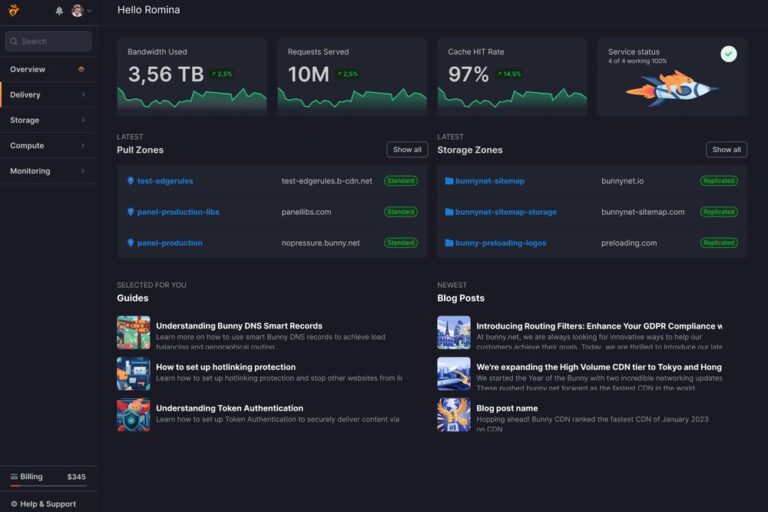
4. A Clean Dashboard
Configuring a content delivery network shouldn’t require days of reading documentation or deciphering convoluted access policies. bunny.net’s management interface focuses on clarity and developer productivity, enabling complete end-to-end deployment in minutes.
Setting up a new Pull Zone involves three basic steps:
- Name your CDN pull zone.
- Enter your origin server’s URL or IP address.
- Select your preferred caching tier and geographic zones.
Once deployed, common configuration tasks that normally require complex server rules can be enabled with a single toggle:
- Free Automated SSL: Provision Let’s Encrypt certificates automatically with one-click installation and renewal.
- Instant Cache Purging: Clear individual URLs or the entire network globally in under a second.
- CORS and Header Controls: Inject Access-Control-Allow-Origin headers or custom security headers directly from the dashboard without touching your origin web server configuration.
- Real-Time Analytics: Monitor traffic volume, cache hit rates, error status codes, and bandwidth distribution down to the second.
This intuitive interface reduces human configuration errors, making it simple to deploy, test, and maintain edge routing rules safely.
5. Robust DDoS Protection and Security
Performance and security go hand in hand. A traffic surge caused by a bot attack or an unmitigated Layer 7 flood can exhaust your web host’s CPU and memory, rendering your site unusable for legitimate visitors. bunny.net protects your infrastructure by filtering malicious requests before they ever reach your origin.
Key integrated security features include:
- Network-Layer DDoS Mitigation: bunny.net’s Anycast network absorbs volumetric Layer 3 and Layer 4 attacks across its distributed edge, preventing traffic spikes from overwhelming your origin host.
- Origin Shield: Designates specific high-capacity edge nodes to act as an intermediate caching layer. Instead of 110+ edge locations requesting cache misses from your server simultaneously, only the Origin Shield queries your origin, drastically reducing host load.
- Token Authentication: Secures private media and downloadable files with signed, time-limited URLs that prevent hotlinking and unauthorized asset scraping.
- IP Blacklisting and Geo-Blocking: Restricts traffic from suspicious IP addresses, entire ASN blocks, or whole geographic regions with simple dashboard controls.
By enforcing security policies at the network perimeter, bunny.net acts as a protective buffer around your origin server—preserving uptime, reducing compute costs, and keeping your application fast under pressure. Start your bunny.net account now.